Images from the Rally to Restore Sanity and/or Fear
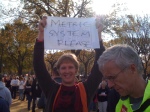
I had a really good time at Jon Stewart’s rally recently. It was great to see and talk to american citizens, who were being so passionate about their political beliefs. There was an enormous crowd at the national mall, and some very witty signs as well!























This blog temporarily resurrects itself to share this awesome video
This is incredibly good. PMQs in the US!!
I think it shows how intelligent a man Obama is. Also, what’s annoying is the incredibly retarded questions that some of those senators ask, given this incredible chance to have a live televised debate on policy! (example, Senator Tom Price at ~ 40 min).
The best sci-fi series in the history of television

If you’re unlucky enough to share my misfortune of not having coming across this series before, then you just have to watch the 14 episodes of Firefly, which is quite possibly one of the greatest television series of all time.
Words cannot describe how good this series is. Just go watch it.
Superstition kills : Part II
Praying man let his daughter die
A US jury has found a man guilty of killing his sick 11-year-old daughter by praying for her recovery rather than seeking medical care.
The man, Dale Neumann, told a court in the state of Wisconsin he believed God could heal his daughter.
She died of a treatable disease – undiagnosed diabetes – at home in rural Wisconsin in March last year, as people surrounded her and prayed.
…“If I go to the doctor, I am putting the doctor before God,” he said. “I am not believing what he said he would do.”
Superstition kills
Indian man ‘sacrifices’ five-year-old girl for male child
A rural Indian witch doctor beheaded a five-year-old girl as part of a bizarre ritual to help a villager produce healthy male heirs, police said Thursday.Vandana Kumari was murdered on Tuesday in Lakhimpur Kheri district, 200 kilometres (124 miles) from the Uttar Pradesh state capital Lucknow, police officer Ravi Srivastava told AFP by telephone.
Occult practitioner Mewalal Chauhan recommended the “human sacrifice” when the child”s neighbour Ram Niwas came to him for help, Srivastava said.
😦
Terror in Mumbai by Dan Reed
You should watch this revealing documentary by Dan Reed on the recent Mumbai terror attacks. From the Mirror,
Dan Reed’s exhaustively researched film builds up a chilling, detailed picture, using CCTV footage, survivors’ testimonies and from police on the scene – who, with their outdated rifles, were powerless to stop the gunmen.
As compelling as these accounts are, it’s the phone conversations between the gunmen and their controllers back in Pakistan – recorded by the Indian intelligence services and aired here for the first time – that are the most revealing.
I have a lot of emotions right now, but I’ll try to keep this short. The actual recorded telephone conversations and CCTV images are gruesome to watch, but highlight the complete lack of preparation our security forces had in tackling such an attack. There’s footage of atleast a dozen police officers running away in the train station together, instead of trying to fire at the terrorists.
It’s also almost surreal listening to the recorded conversations between the terrorists and their handlers, as they receive *live* instructions on where to attack and what to set on fire *after* getting into the hotel. Was this information even available during the counter-terrorism response? If this was known, why were live feeds of the security activities allowed to be broadcast by the TV networks? I can only hope that our security forces have learned a lot from this incident.
There’s also a conversation with Kasab which is shown, where the police questioner asks him about his motivations. It’s easy to label the terrorists as inhuman, and devoid of human emotion, but the religious conviction which they’ve been brainwashed with in order to justify their acts is incredibly sad to watch. The recorded telephone conversations show how they are repeatedly reminded by their handlers that they should not get arrested and should die, and that God will reward them. It’s going to be education, rationalism and literacy which can prevent such people from turning into terrorists.
QOTD
From a ‘senior vatican official‘
“We have laws, we have a discipline, we have a doctrine of the faith,” the official says. “This is not just theory. And you can’t start backpedaling just because the real-life situation carries a certain human weight.”
Not all opinions are equally valid
In the context of any discussion or a debate, it’s essential to remember that not all opinions are equally valid; some of them are based on reason, rationality, empirical evidence and ethics, while others are based on ignorance, pseudoscience, superstition and religion.
The recent Delhi High Court ruling in India which ‘decriminalized’ homosexuality is a landmark civil rights milestone in India’s history which recognizes equality and affirms individual human rights. However, this is not enough. I hope that this judicial ruling is the first step towards eventually legalizing gay marriage, and granting equal civil rights to all citizens, irrespective of their sexual orientation.
However, what is sadly predictable is the reaction of almost every religious group, who readily unite in their moral outrage to condemn this ruling.
“We urge the union and Delhi governments to keep in mind the views of various religious committees while taking a stand on the judgement of the Delhi High Court,” Jain religious leader Acharya Lokesh Muniji told reporters at a press conference of religious leaders in New Delhi on Thursday. “It’s not that we don’t support independence of individuals but this judgment challenges the will of god”
Sharing the platform with Muniji was the president of Jamaat-e-Islaami Hind, Maulana Syed Jalaluddin Umari. The Maulana said that according to Islam homosexuality is a crime. “Such behaviour is against the moral values of our nation that is based on cultural and ethical traditions. The government should take our views seriously.”
Agreeing with him was Sardar Tarsem Singh of the Delhi Sikh Gurdwara Prabandhak Committee. “Sikh religion doesn’t view homosexuals as criminals but we don’t encourage it.”
Father Dominic Emmanuel, the founder of Sarvadharma Sadbhav (Communal Harmony and Peace), said: “We have no objection or opposition to de-criminalisation of homosexuality because we never considered them (homosexuals) as criminals”. “However, we are also clear that we are against legalising it… because what they do is unnatural and against the design and will of god.”
But wait… Father Dominic is of the opinion that homosexuality is unnatural and is against legalizing it, but has no objection to de-criminalization? WTF? This sort of broken and contradictory thinking is exactly why one should remember that not all opinions are equally valid.
Frankly speaking, the objections against decriminalizing homosexuality are bereft of facts, logic and evidence; against human rights and promote bigotry. Religious groups should ideally have no say whatsoever in this issue, because India is a secular democracy, and we have a rational-legal judicial system, not one based on any religious text. Religious groups have no right whatsoever to impose their moral viewpoints as universal law 1.
Here’s a nonsensical petition which attempts to reverse the Delhi High Court ruling, filed by SK Kaushal, who happens to be an astrolger 2
The petition filed by Kaushal sought quashing of July 2 verdict of the high court legalising gay sex between consenting adults in private, which was earlier a criminal offence punishable with upto life imprisonment.
The petition contended that homosexual acts, by all standards, were “unnatural” and could not be permitted.
“No one can imagine the consequences of the unnatural acts. Even animals don’t indulge in such activities,” he said in his petition.
He said the high court judgement would result in spread of HIV virus as “it has been amply proven” that the infection was contracted through such sexual acts.
Really?
- How can it be unnatural if it occurs in nature? Also, the internal combustion engine is unnatural, but that doesn’t mean it should be illegal.
- ‘Even animals don’t indulge in such activities’ – Hogwash. There’s documented evidence of homosexual behaviour in animals. All he needed to do was google. Also, this is an irrelevant point.
- “it has been amply proven that the infection was contracted through such sexual acts.” – Gee, doesn’t that imply that we should ban hetrosexuality too? In any case, it’s pathetic that he doesn’t realize that decriminalizing homosexuality would be an immense step in preventing the spread of HIV in that population group.
There are some issues which I wish to address. First, why aren’t such silly petitions dismissed by the SC? Second, it goes to show how poorly we think of politicians, that it comes as no surprise that political parties are not taking an unequivocal stand on an issue of human rights. Then, when politicians, religious groups, or organizations calls for a ‘wider consensus’, it’s important to realize that human rights issues should not decided by popular vote, (ideally) the constitution should guarantee fundamental human rights by law, and the judiciary should ensure this.
Finally, I’m against labelling any opposition to the high court decision decriminalizing homosexuality as worthy of a ‘debate’, as that usually implies that there are two sets of comparable but opposing opinions.
Fact is, if you think that homosexuality should be a criminal offense punishable by law, then you are stupid and ignorant.
Notes
[1] – And yet they attempt to do this all the time, and sometimes manage to pull it off (ex. prop 8, blasphemy laws, etc). Which is one of the reasons I think religion is very damaging.
[2]- *Ahem*
Deepak Chopra is superman!
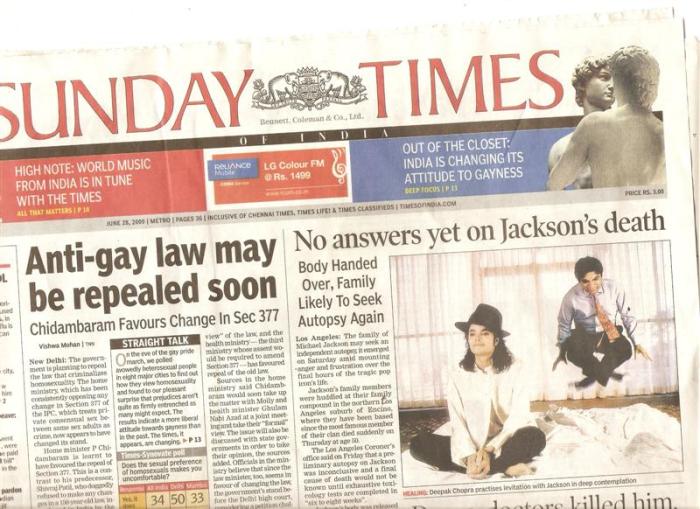
Deepak Chopra practices levitation with Jackson in deep contemplation
I wonder what MJ was contemplating? Perhaps he thought, “Now that’s off the wall”. Or maybe twas “This guy sure can jump high from a squat!”.
But I’m pretty sure it wasn’t: “Why does the TOI print such drivel?”

 All original work on this blog is licensed under a
  A Candle in the Dark